
In Burnside, Devyn Defoe paints an end-of-days portrait of two young women in California that manages to make you laugh, break your heart, and double-check that you’re actually awake and not in some absurdist hallucination. Referred to as a “signature chronicle of our American endtimes” by author Chang-rae Lee, Defoe’s unforgettable characters navigate patriarchy, climate crises, and a whole host of issues for which we can thank late-stage capitalism.
I sat down with Devyn Defoe to discuss how Burnside came to be, the enduring influence of Lemony Snicket, and the endless rewards of bookselling.
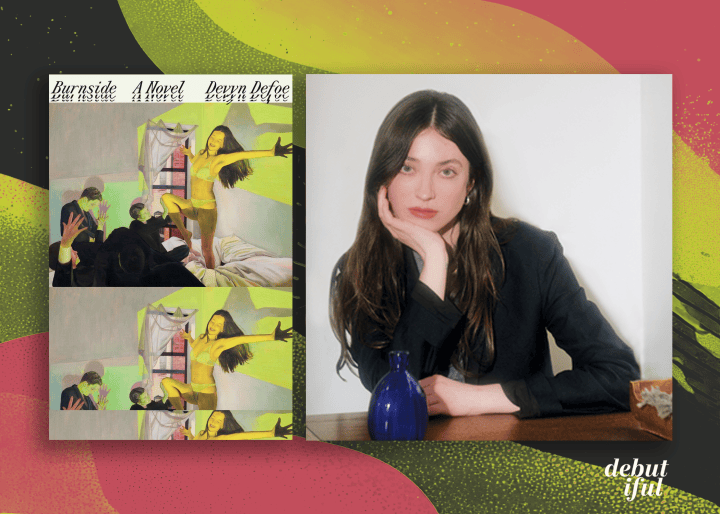
Viviana Freyer: I’d love to hear about the origins of this book and how it came together. Was it the characters that came first, or was there a theme that you really wanted to talk about ?
Devyn Defoe: I think, first, the setting. I had moved back to Sacramento the year I started, [and] I always wanted to have a book set in Sacramento, so it just seemed like the right time. [As for] the characters…I was kind of teaching myself how to write a novel, in a way. So it was piece by piece, and the plot sort of emerged very gradually. It was really just feeling my way through the whole thing. But it was definitely the setting and the two girl characters from the start.
VF: Was there a certain book that you read as a child or an adolescent that made you want to be a writer?
DD: From the Mixed-Up Files of Mrs. Basil E. Frankweiler [by E.L. Konigsburg]…that was huge for me…I loved the Lemony Snicket books.
VF: That tracks.
DD: I feel like there’s some influence that can totally be seen. I think I learned a lot about how to write place in [A Series of Unfortunate Events]. The settings are very general and referential, and they kind of go all over the place. It was a good education.
VF: I’m always very curious about authors’ different writing processes. How long did it take you to write Burnside? Did you show it to people?
DD: It took a long time to write. I started it my second year of the [Wallace] Stegner Fellowship, so I was sharing it with those people. That was very helpful in the first step, but after that I was really just keeping it to myself and not getting feedback. At that point it slowed down because…I was kind of just figuring all the pieces out myself, which took quite a while…The ending was really challenging to land on and figure out. So I took a while to just really get to the place where I knew how to end it. But then once I got there, it was pretty much the complete book. And that was when I realized kind of what it was, but it took a few years to get there.
VF: What misconceptions do you feel like you had about writing a novel?
DD: I guess that I had the idea that…if you have a lot of time that you can just knock out a novel. I didn’t finish the book by the end of the fellowship, and it just took a lot of figuring out afterwards. A book is just going to take as much time as it takes, and I have very little control over that…it’s definitely not ‘writing x many words per day, and when you stack that up you have a finished novel.” I don’t believe that anymore.
VF: I know you’re a bookseller, so was I, actually! In what ways do you feel like bookselling prepared you for a debut novel or a career as a novelist?
DD: Sort of in every way. I think it’s kind of the perfect job in so many ways. It’s funny because I got my job after I started writing the book, so I wasn’t writing about [bookselling], per say. The fact that I work at a used bookstore…we do have new stuff too, but mostly just buying and selling used books…That was so beneficial because you see just random stuff all the time that either you didn’t know about or you’re like “Oh, I was meaning to read that. Now I have the chance!” And I found a lot of writers that way that have become really important to me and the book in particular.
And just commercially, having the knowledge of what sells, that was really helpful in terms of working with my publisher on [Burnside]…it was originally going to be hardcover, and then my editor brought up paperback, and I was like, “That makes so much sense because paperbacks sell better. I see that every day at work…” Practical things like that were kind of helpful in just navigating that process. Business things.
[Bookselling] is also just such an easy job to slot your creative routine around. You also just meet really cool people there.
VF: I’ve seen “Lynchian” get thrown around in a lot of your [promotional] copy, and I definitely see why people are seeing that, but if you were to put your novel in conversation with any other novels or novelists, who would that be?
DD: I was originally inspired to take on the project after I read Milkman by Anna Burns…which is so genius. I think that definitely towards the beginning there were a lot of similarities…She just has an incredible language in that book…The protagonist is this young woman during The Troubles in Ireland, and she’s sort of pulled into this community drama that she doesn’t want to be involved in…Young women are often seen as frivolous or like our stories aren’t political when they completely are, by virtue of us living them and having to deal with all these problems.
VF: I feel like so much of the modern reading experience is centered around feelings and how books make you feel. You see lists on TikTok of “books that feel like a fever dream” or “books that do this” or “books that do that.” I see your book get described as a “fever dream” a bunch, actually. Are there any feelings or impressions that you hope personally linger?
DD: I very much don’t want to tell people how to read the book. I’m kind of curious in the ways it is being read. It’s always interesting hearing those terms people say…I think there is such a huge darkness in the book that I hope is given its full weight…There’s a lot of funny parts. I’ve heard the word “quirky” as well. The narrator is very much grappling with existential terrors in a lot of ways, so I hope that that element does come across. Not that everyone should be completely depressed by the end of reading it, that’s not the point. Just that these things be talked about, I hope.
VF: You mentioned earlier in the interview that you really wanted to write about Sacramento, and that writing about place is important to you. What are some of your favorite depictions of California?
DD: I think the Lemony Snicket books are based on San Francisco…On The Road is coming to mind…I have to say William Vollmann is a great Sacramento writer…as well as Joan Didion, of course. I cannot believe I nearly forgot those two.
VF: Last year at the bookshop, Aaron John Curtis released his own book, who also got interviewed by Debutiful. It was a really exciting time at the shop. There might be no better place to celebrate a debut than an indie bookshop.
DD: It turns out I’ll be in New York for the release date, but there was a time where we were going to do the launch there. I work on Tuesdays anyway, but I was like, “I just want to work that day!”
ABOUT THE AUTHOR: Devyn Defoe is a writer and bookseller from Sacramento, CA. A former Wallace Stegner Fellow, her work has been published by Socrates on the Beach and The White Review. Burnside is her first novel.
ABOUT THE INTERVIEWER: Viviana Freyer grew up in Miami. She has been an editorial assistant, a preschool teacher, a film festival judge, and an independent bookseller. She writes about literature and film.
Editor’s note: we erroniously used a photo taken by Max Whittaker for Sactown Magazine in our original graphic. Please read the article written by Hillary Louise Johnson and support local journalism.
I really enjoyed this guest post because it captured that strange balance between serious themes and playful imagination. The references to Lemony Snicket made me smile, especially since that mix of dark humor and heart can leave a lasting impression on readers. It’s always fascinating to hear how different books quietly shape an author’s voice over time. I also love that inspiration can come from the most unexpected places. Was there one childhood book that influenced your writing more than all the others combined?