
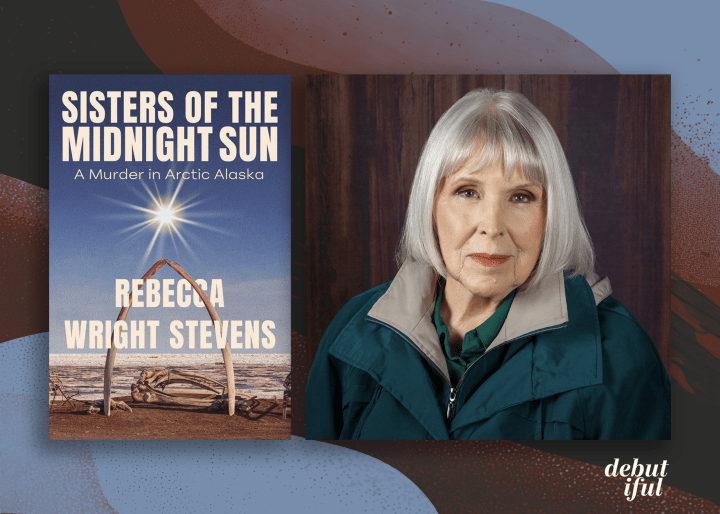
In Sisters of the Midnight Sun, Rebecca Wright Stevens has crafted a compelling nonfiction story about the real-life double homicide of two sisters within the Alaskan Iñupiat community. Drawing on her experience as a public defender assigned to one murder suspect, the book is a portrait of a community affected by violence against Native women. The book weaves together personal moments in Stevens’ life with specifics of her work on the murder case.
Sisters of the Midnight Sun is both a gripping crime narrative and a self-portrait (Stevens declares herself an outsider.) Her descriptions are sharp and vivid throughout. And her depiction of setting is compelling, from courtroom scenes to the Alaskan landscape. The book’s title nods to how the sun can stay out for 24 hours in northern Alaskan summers. Stevens describes it as a “sun so bright it made your eyes wince until you could get behind blackout curtains and hide.” Stevens has written a book that is singular and unflinching.
We spoke via email with Stevens about the years she spent writing Sisters of the Midnight Sun, her inspirations, and the difficulty of placing a book that blends genres.
This interview has been edited and condensed for clarity.
Athena Waligore: The double homicide at the core of “Sisters of the Midnight Sun” occurred in 1993. When did you consider turning that story into a book?
Rebecca Wright Stevens: At the time, the case kept waking me up at night. The sisters were murdered in a town of less than 5,000 people that is not connected by road with any other town. The only access is by air, and Public Safety watches the airport. So the killer was still among us – but who was it? I kept a journal about the case.
AW: How long did the book take you and what was the process to write it and to share it?
RS: Retiring from law in 2017, I had time to put together a manuscript based on the journal – but the whole process took 10 years. The first agent who represented the manuscript was unable to place it with a publisher, and I began to feel the story would never be told. But Elizabeth Kracht of Kimberley Cameron, whom I had met at a Pacific Northwest Writers Association conference, took it up, and found a great home for it with Counterpoint, editor Dan Lopez. I thought I was happy and done. Wrong. Much editing and polishing lay ahead. With their suggestions, I re-edited and re-polished the manuscript over a dozen times. It is now a much better book than when Liz and Dan first looked at it. After its slow start, “Sisters” has been included in Oprah Daily’s “Best Books of Summer,” and the New York Times’s list of “Nonfiction Everyone Will Be Reading This Summer.”
AW: This book is non-fiction, but the pace feels influenced by thrillers. There are also touches of vulnerability and revelation that are akin to memoir. How did you settle on the book’s form?
RS: I didn’t attempt to write according to any formula, just to tell the story. Perhaps the fact that the resulting manuscript did not fit neatly into a genre is one reason it was initially hard to place. Some reviewers have praised it for its variation. Publishers Weekly called it “an engrossing blend of memoir, travelogue, and courtroom drama about a double murder in the wilds of Alaska,” and author Peter Houlahan said it was “a gorgeously crafted fusion of true crime, murder mystery, legal thriller, and one woman’s passage from personal devastation to hard-won triumph.”
AW: Over your four decades as a public defender, the true crime phenomenon got much more popular. Did you find yourself captivated by any cases, whether in books, podcasts, tv, or otherwise?
RS: Years ago, when I was a young Navy wife and my husband was out on submarine patrol, I made the awful mistake of reading Truman Capote’s In Cold Blood late one night. It scared me silly. I slept only during daylight until my husband returned from sea. Capote’s searing realism and unforgettable portraits of the victim family and of tragic Perry Smith opened the door for The Executioner’s Song, Fatal Vision, and all the documentaries and podcasts that followed. I think the interest in true crime reminds public defenders everywhere of the importance of their work.
AW: What other books influenced Sisters of the Midnight Sun?
RS: American author Willa Cather is my writing idol. Some of her works are so vivid to me that I have found myself saying in conversation, “Oh, that reminds me of . . . ,” and then beginning to tell an anecdote before remembering it was a Cather story, not my own experience. At the top of my bucket list is an Amtrak trip to her childhood home in Red Cloud, Nebraska, much of which is now preserved in her honor, to see the rose-print wallpaper she put up with her own hands as a teenager in her attic eyrie.
AW: How did the changing seasons affect this story?
RS: During the endless shine-dazzle of the Arctic summer sun, witnesses could not quite remember what time they had last seen the sisters, Saturday night, after the fiancé of one of the sisters had gone home on the last bus of the evening, or Sunday night, after my client, Amos Lane, had returned to the alcohol treatment facility from his weekend pass. No one could say who was with them last. When there’s no night, there’s no difference between midnight on Saturday and noon on Sunday.
AW: The book centers around two Indigenous sisters who were violently murdered. And you note in the book that this is of course part of a larger problem of Native women who are murdered and who go missing. Did this book feel like a way to shed light on that violence?
RS: Also mentioned in the book: a Native Alaskan social worker came by the office one afternoon to let me know she would not be at an upcoming hearing because she had to make an emergency trip Anchorage. Her missing daughter was just found, still alive in the shallow grave where she was dumped when the person who had hurt her was done with her. I had not known the young woman was missing, there was no story in the local paper. This outrage should have been headlines in all nearby media. Sometimes people feel they are “respecting the family” by staying silent, but atrocities that remain unknown are not addressed and generate no accountability.
ABOUT THE AUTHOR: Rebecca Wright Stevens is a retired public defender with a double major in English and Spanish from the University of Kansas in Lawrence and a juris doctor degree from the University of Memphis. She lives with her husband in a log home in the woods of Tennessee.
ABOUT THE INTERVIEWER: Athena Waligore is a Brooklyn-based writer and journalist. She was previously an editor at Interior Design magazine and currently manages communications for NYC’s public works agency. She writes fiction and is currently working on a novel.